English · 中文
Put agents on your production signals without handing them the keys.
A signal comes in: an alert, a chat message, a ticket, a timer. A pipe signs, routes and prices it. An agent investigates it read-only, and proves it is read-only at startup. The report reaches a person as a card they can rule on. Nothing touches production without a signed press.
| service | what it does |
|---|---|
hookrelay |
The pipe. Adapts any webhook, routes it, delivers to chat, and keeps one ledger of every hop. |
hookjudge |
The judge. Decides cheaply whether a person must act now. Most events never pay for a model. |
hookprobe |
The investigator. One read-only agent run per event, behind an OpenClaw-compatible HTTP contract. It also runs on its own. |
The investigator is the product. The pipe and the judge are the smallest alerting front end for a team that has none. One deployment is one team: this is not a work-management platform, a multi-tenant SaaS or an agent framework.
Start here
- 30 seconds: docs/quickstart.md opens with the shape of it — three services, one diagram.
-
10 minutes, no keys, no bill: pipe + judge + a stub model + the investigator on a rehearsal + a readable sink. Docker is the only prerequisite.
curl -fsSLO https://raw.githubusercontent.com/itswl/hookstack/main/docker-compose.quickstart.yml
docker compose -f docker-compose.quickstart.yml up -d
bash <(curl -fsSL https://raw.githubusercontent.com/itswl/hookstack/main/scripts/demo.sh)
The demo runs the whole loop: an alert judged, a recorded investigation replayed through the real read-only gate, the report as a card, an approve press running two allowlisted commands, the alert resolved. docs/quickstart.md has the rest of it — a real model, the boards, the half-day path.
- Half a day, for real: STACK.md runs all three from source; docs/containment.md is the boundary map you read before pointing it at a cluster.
- What it does, in full: docs/what-you-get.md.
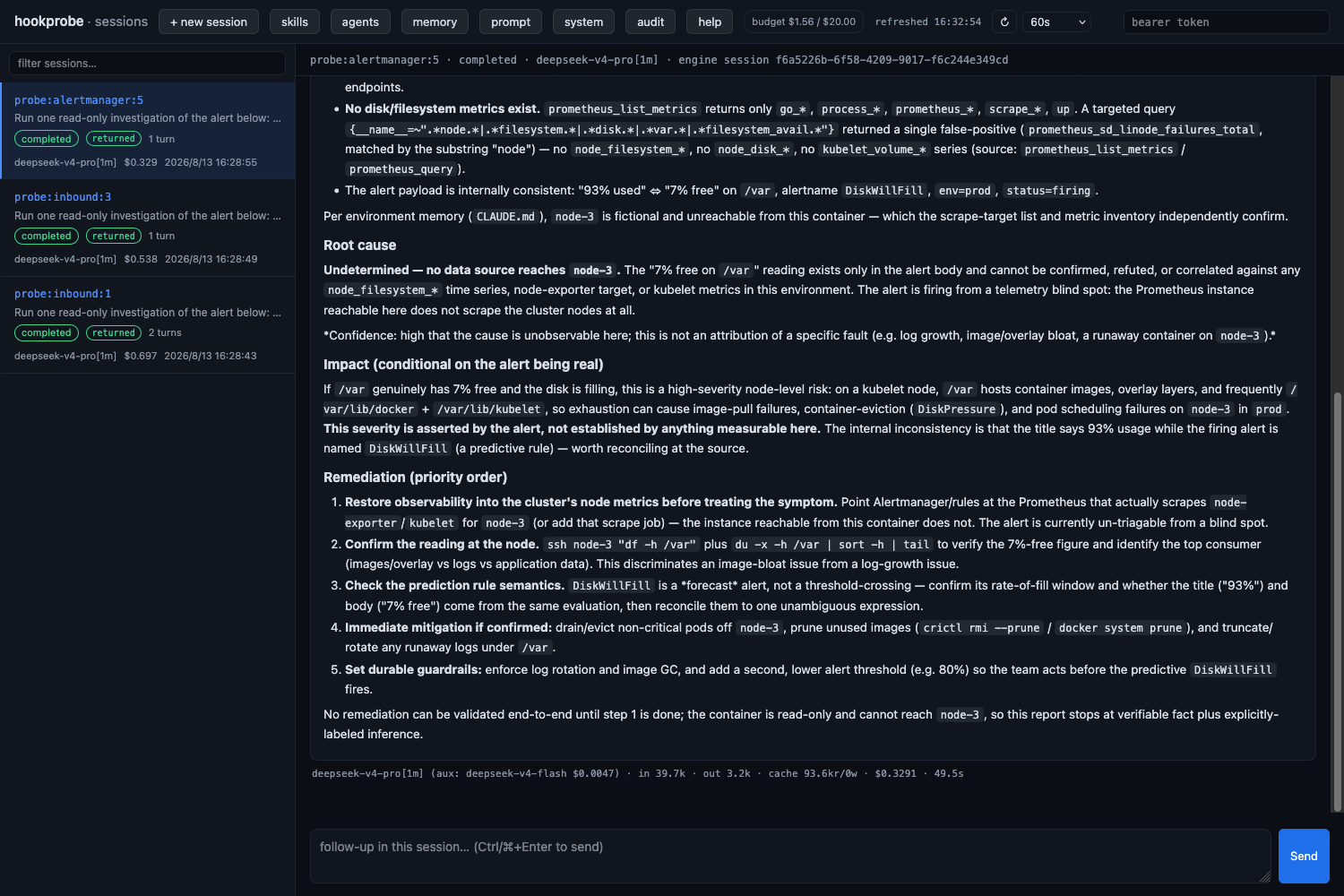
The three boards read in Chinese or English and follow the system’s light or dark; the full tour has every screenshot, from local runs and not mockups.
How it fits together
upstreams ──► hookrelay ──► hookjudge ──► hookrelay ──► chat bridge / webhook
                  │
                  └──► hookprobe ──► hookrelay ──► the same channels
                       (critical/high; a rehearsal until it has a model)
The same pipe also carries an operator’s own work signals to a planner and, on a person’s press, to a work runner (two deployment shapes, one codebase).
Read more
- Full narrative overview
- hookprobe reference
- Running all of hookstack
- Containment — the security boundaries
MIT licensed.